


DIY: The "Big 3" wire upgrade


Senior Member
Joined: Jul 2010
Posts: 730
Likes: 0
From: United States
Vehicle: 2001 Hyundai Tiburon

12 volts is 12 volts no matter how you look at it
i dont see how leaving factory wire still connected and adding the additional 0 guage for the big 3 upgrade would change anything, its still 12 volts
i dont see how leaving factory wire still connected and adding the additional 0 guage for the big 3 upgrade would change anything, its still 12 volts

Senior Member
Joined: Oct 2007
Posts: 180
Likes: 0
From: Newark, Delaware
Vehicle: 2001 Hyundai Tiburon
water pipes are just water pipes as well then right? What's the difference if you just ran house copper tubing under the streets as the main water line to houses? Very little flow of water to the houses. Use a 12" diameter pipe under the streets and feed the houses with that, lots of volume of water to each house. same concept.
I hope my analogy works.
I hope my analogy works.

Moderator


Joined: Feb 2009
Posts: 11,732
Likes: 5
From: Leesville, Louisiana
Vehicle: 2001 Hyundai Tiburon
The point of the upgrade is that an electrical system is only as good as it's weakest link. Water is a common example used in electronics.
So, say you've got a hose draining into a bucket and you've got a hole in the bucket to let the water out into the drain. Maybe that hole is big enough, maybe it's not. If you make that hole bigger, then sure it works. Why not just drill another hole into the bucket?
Grounding is a tricky thing. The size of the wire is important, but the quality of the connection is even more important. If you've got a 2 gauge wire connected to the engine but it's surface contact is equivalant to a paperclip, then that's not doing much. If you have a nice firm connection then it's much better. Multiple good connections ensures better contact. The more connections you have to ground the better flow of electricity there is.
The actual answer to your question of voltage can be found here in this american wire gauge table as well as the calculator at the bottom of the page. http://www.powerstream.com/Wire_Size.htm . As you increase the current flowing through a wire, depending on the cross sectional value, the voltage, the amperage and even the natural resistance of copper itself, the voltage will drop lower. A wire can only handle so much amperage and as you get closer to the maximum, it increases in resistance. Increasing the size and ammount of wires connecting the source and destination will help to eliminate the voltage potential difference between the source and the destination.
Don't read that as you need 5 0000AWG wires grounding your vehicle. 1 additonal 2AWG wire will more then suffice. Keep the manufacturer's grounding in place as an extra connection.
So, say you've got a hose draining into a bucket and you've got a hole in the bucket to let the water out into the drain. Maybe that hole is big enough, maybe it's not. If you make that hole bigger, then sure it works. Why not just drill another hole into the bucket?
Grounding is a tricky thing. The size of the wire is important, but the quality of the connection is even more important. If you've got a 2 gauge wire connected to the engine but it's surface contact is equivalant to a paperclip, then that's not doing much. If you have a nice firm connection then it's much better. Multiple good connections ensures better contact. The more connections you have to ground the better flow of electricity there is.
The actual answer to your question of voltage can be found here in this american wire gauge table as well as the calculator at the bottom of the page. http://www.powerstream.com/Wire_Size.htm . As you increase the current flowing through a wire, depending on the cross sectional value, the voltage, the amperage and even the natural resistance of copper itself, the voltage will drop lower. A wire can only handle so much amperage and as you get closer to the maximum, it increases in resistance. Increasing the size and ammount of wires connecting the source and destination will help to eliminate the voltage potential difference between the source and the destination.
Don't read that as you need 5 0000AWG wires grounding your vehicle. 1 additonal 2AWG wire will more then suffice. Keep the manufacturer's grounding in place as an extra connection.
Senior Member
Joined: Jul 2010
Posts: 730
Likes: 0
From: United States
Vehicle: 2001 Hyundai Tiburon
the way i understood it is;
leave stock power wire from alternator connected to the battery
then add another power (0-4g) along the same path
is that the concept?
if so, it wouldn't make sense
leave stock power wire from alternator connected to the battery
then add another power (0-4g) along the same path
is that the concept?
if so, it wouldn't make sense

Senior Member
Joined: Sep 2008
Posts: 786
Likes: 0
From: South Dakota
Vehicle: 2000/Hyundai/Tiburon
how doesnt it make sense?
current travels through the wire with the least resistance, by keeping the stock one there you give it another path to follow just in case... its not that difficult a concept to get
current travels through the wire with the least resistance, by keeping the stock one there you give it another path to follow just in case... its not that difficult a concept to get
Moderator
Joined: Feb 2009
Posts: 11,732
Likes: 5
From: Leesville, Louisiana
Vehicle: 2001 Hyundai Tiburon
Use a different location for the 2nd ground wire. There's plenty of bolts on the transmission to choose from. Get a 24" battery terminal cable, cut the ends off of it, use the proper crimp on ring connectors. Also, get a copper washer for a better connection and clean off the metal area you've chosen with a brass wire brush or emery cloth.
There's enough metal on metal contact with all the bolts and hardware securing the transmission to the transmission that it would be electrically the same. You should be able to find a suitable bolt nearly under the battery box.
There's enough metal on metal contact with all the bolts and hardware securing the transmission to the transmission that it would be electrically the same. You should be able to find a suitable bolt nearly under the battery box.

Senior Member
Joined: Mar 2002
Posts: 34,642
Likes: 0
From: Los Lunas, New Mexico, USA.
Vehicle: 2001 Hyundai Tiburon, 2004 Kia Sorento, 2010 Kia Soul
<div class='quotetop'>QUOTE (bigfishmoney @ Feb 27 2009, 03:50 PM) <{POST_SNAPBACK}></div><div class='quotemain'>the way i understood it is;
leave stock power wire from alternator connected to the battery
then add another power (0-4g) along the same path
is that the concept?
if so, it wouldn't make sense</div>
Read the entire thread, it is explained several times.
leave stock power wire from alternator connected to the battery
then add another power (0-4g) along the same path
is that the concept?
if so, it wouldn't make sense</div>
Read the entire thread, it is explained several times.

Senior Member
Joined: Feb 2009
Posts: 1,932
Likes: 0
From: Boston
Vehicle: 2006 Pontiac GTO
If you add an alternator to battery cable, PLEASE PLEASE don't forget to fuse it near the battery. If the wire somehow gets cut or melted, the short can cause a fire, or the battery may even explode.
You can remove the stock wire/fuse; If you keep the stock wire and 100A fuse, you can use something like a 80-90A fuse on the new wire. The idea being that the current flows through both wires, inversely-proportional to their resistances (for example. if the new wire has 4 times less resistance, then 4 times more current will flow through it, so if 100A is flowing through both wires, 100/(4+1) = 20A will flow through the old wire and 20*4 = 80A will flow through the new wire).
The table on this wiki page will show you the resistance of wires depending on AWG http://en.wikipedia.org/wiki/American_wire_gauge
You can remove the stock wire/fuse; If you keep the stock wire and 100A fuse, you can use something like a 80-90A fuse on the new wire. The idea being that the current flows through both wires, inversely-proportional to their resistances (for example. if the new wire has 4 times less resistance, then 4 times more current will flow through it, so if 100A is flowing through both wires, 100/(4+1) = 20A will flow through the old wire and 20*4 = 80A will flow through the new wire).
The table on this wiki page will show you the resistance of wires depending on AWG http://en.wikipedia.org/wiki/American_wire_gauge
Moderator
Joined: Feb 2009
Posts: 11,732
Likes: 5
From: Leesville, Louisiana
Vehicle: 2001 Hyundai Tiburon
I have not done the power upgrade yet because I have no idea what it will do to the sense line. The resistance of the copper wire may have an effect on the sense line. I really don't know what it does or why it goes all the way out to the fuse box before returning back to the alternator. It would be safest to run it all to the screw on the corner of the fuse box.
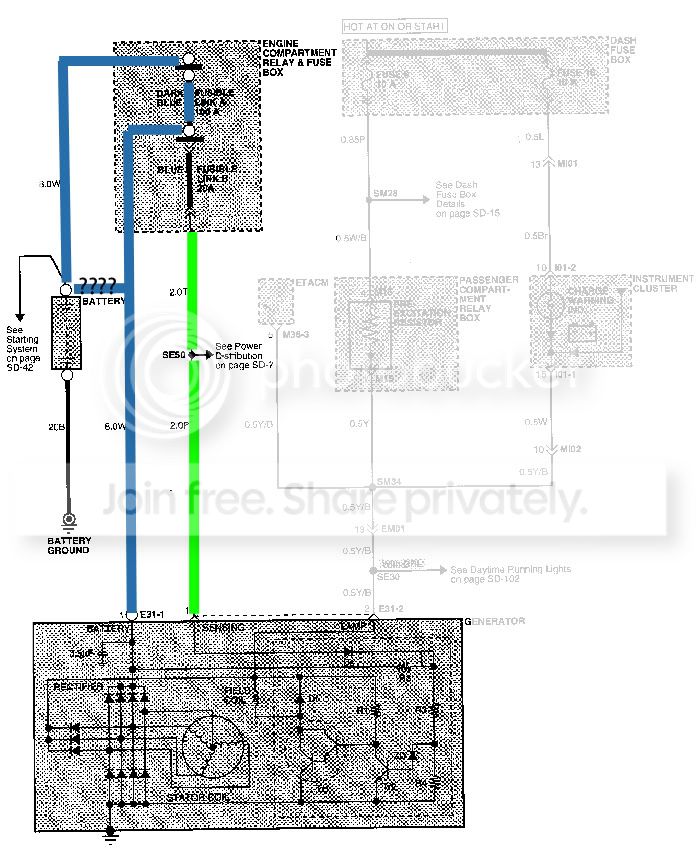
I just realized that the entire purpose of the generator circuit as drawn here, is simply for turning on and off the check engine light. However, there may be more to that sense line then what is drawn
I just realized that the entire purpose of the generator circuit as drawn here, is simply for turning on and off the check engine light. However, there may be more to that sense line then what is drawn

