


Why such a huge price difference with catch cans


Thread Starter
Member

Joined: Dec 2011
Posts: 75
Likes: 0
From: Miami, FL
Vehicle: 2011 Genesis 2.0 R Spec
 Why such a huge price difference with catch cans
This one is only $20
http://www.ebay.com/itm/Black-Univer...BV3pCu&vxp=mtr
This one is $112
http://www.ebay.com/itm/MISHIMOTO-Oi...dV-xmB&vxp=mtr
This one is $230
http://www.ebay.com/itm/PREDATOR-OIL...VViIX2&vxp=mtr
What gives? Why the big difference in price? I see a bunch of other ones that between $15-$30 and others that are between $75-100. I dont get it
http://www.ebay.com/itm/Black-Univer...BV3pCu&vxp=mtr
This one is $112
http://www.ebay.com/itm/MISHIMOTO-Oi...dV-xmB&vxp=mtr
This one is $230
http://www.ebay.com/itm/PREDATOR-OIL...VViIX2&vxp=mtr
What gives? Why the big difference in price? I see a bunch of other ones that between $15-$30 and others that are between $75-100. I dont get it

Senior Member
Joined: Mar 2008
Posts: 4,185
Likes: 0
From: Atlanta, GA
Vehicle: MC + RD2 + AW11 + 944 = 4x Win
There are a ton of differences in catch cans. The $20 jobs are typically shoddy steel crap with no baffling or filtration. Basically just the north side of a coke can DIY.
The best cans are baffled, aluminum and chambered to allow only clean air without impeding vacuum pressure. It depends how crazy you want to go, but research will be key.
IMHO, buy from a reputable company not ebay. It's the safest way to prevent getting ripped of, over paying for an inferior product.
The best cans are baffled, aluminum and chambered to allow only clean air without impeding vacuum pressure. It depends how crazy you want to go, but research will be key.
IMHO, buy from a reputable company not ebay. It's the safest way to prevent getting ripped of, over paying for an inferior product.

Senior Member
Joined: Sep 2007
Posts: 962
Likes: 0
From: Elkhart, IN
Vehicle: 2003 Tiburón GT
the catch can from the last link is the best one. The shop owners are old Hyundai enthusiast and the master fabricator worked for AMS before moving to PR to work for them.

Moderator

Joined: May 2001
Posts: 7,166
Likes: 6
From: San Antonio, TEXAS!!!
Vehicle: 01 Tiburon Turbo, 99 Tiburon F2E, 2013 Avalon XLE Touring
They all look aluminum. But, the cheaper ones have a sight gauge that I personally don't trust for fear of rotting, leaking, and turning brown/opaque. The fittings on the cheaper ones are "cheap". So are the hoses.
The expensive one has better hose, but not the best IMO. The fittings are better. And it's application specific which means bolt on, whereas the others would require some fab work to mount.
Personally, I would go with a more universal can with baffeling, then make my own fitting and hose assembly. It's what I did to the Tib. I paid well over $100 for the can and at least that on fittings and hose.
(Let me whore my setup)
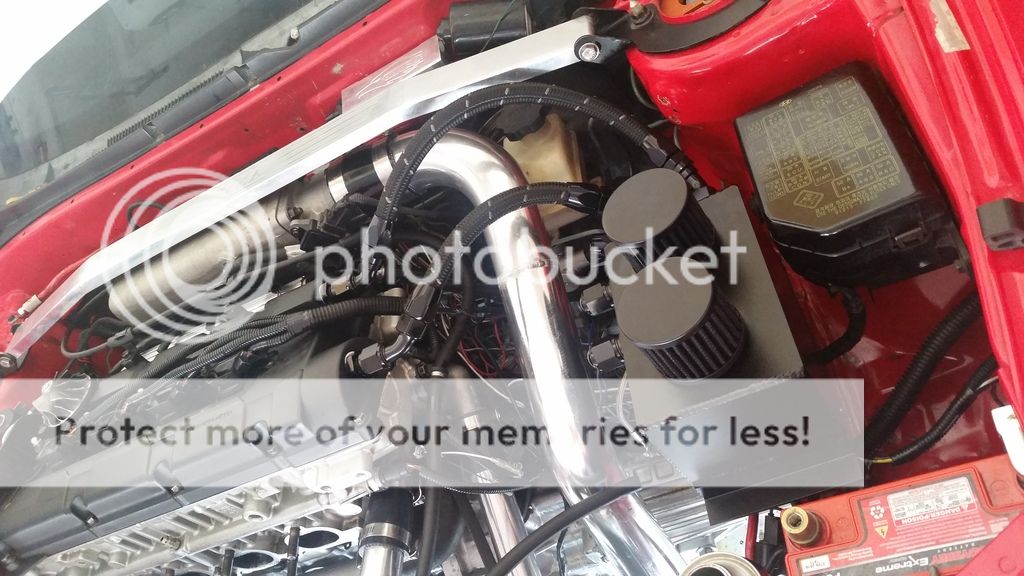
The expensive one has better hose, but not the best IMO. The fittings are better. And it's application specific which means bolt on, whereas the others would require some fab work to mount.
Personally, I would go with a more universal can with baffeling, then make my own fitting and hose assembly. It's what I did to the Tib. I paid well over $100 for the can and at least that on fittings and hose.
(Let me whore my setup)

Senior Member
Joined: Mar 2010
Posts: 2,615
Likes: 11
From: Denver Co
Vehicle: 1999 Hyundai Tiburon
I like your oil cap. 
Yeah, what Jon said. Get a reasonably priced baffled can and mod as needed. I put a drain and ball valve in the bottom of mine with a line long enough so when it's time to change the oil, I simply open the valve and let her drain. Super easy and only about an extra 20 bucks in parts.
Yeah, what Jon said. Get a reasonably priced baffled can and mod as needed. I put a drain and ball valve in the bottom of mine with a line long enough so when it's time to change the oil, I simply open the valve and let her drain. Super easy and only about an extra 20 bucks in parts.

Moderator
Joined: May 2001
Posts: 7,166
Likes: 6
From: San Antonio, TEXAS!!!
Vehicle: 01 Tiburon Turbo, 99 Tiburon F2E, 2013 Avalon XLE Touring
It also depends on your goals. If you plan to use uber-boost, then you'll want to vent the valve cover and block, which requires multiple fittings, plus a filtered vent. The vents and lines need to flow freely without clogging.

Junior Member
Joined: Jan 2016
Posts: 1
Likes: 0
From: DE
Vehicle: Chevrolet Camaro SS
This one is only $20
http://www.ebay.com/itm/Black-Univer...BV3pCu&vxp=mtr
This one is $112
http://www.ebay.com/itm/MISHIMOTO-Oi...dV-xmB&vxp=mtr
This one is $230
http://www.ebay.com/itm/PREDATOR-OIL...VViIX2&vxp=mtr
What gives? Why the big difference in price? I see a bunch of other ones that between $15-$30 and others that are between $75-100. I dont get it
http://www.ebay.com/itm/Black-Univer...BV3pCu&vxp=mtr
This one is $112
http://www.ebay.com/itm/MISHIMOTO-Oi...dV-xmB&vxp=mtr
This one is $230
http://www.ebay.com/itm/PREDATOR-OIL...VViIX2&vxp=mtr
What gives? Why the big difference in price? I see a bunch of other ones that between $15-$30 and others that are between $75-100. I dont get it
There is a wide range of catch cans available, all with different features and inclusions. The goal of this product is all the same, to separate oil particles from CCV air before re-entry into the intake tract. Most of the less expensive options are essentially a single chamber aluminum can with fittings for entry and exit. Some may also include a mesh or steel wool material for filtration or condensation. Higher end catch cans will include internal baffling to prevent fluid sloshing and provide interior surface area for oil to condense upon. Below is a look at the interior components of our recently designed compact baffled oil catch can.

Each component plays an important role in oil separation.
Air Diverter – As the air/oil mixture enters the catch can, the diverter is the first component it hits. This piece is oriented on the inlet. It pushes air around the can to maximize separation.
Internal Baffle – This baffle design serves two functions. First, it prevents oil from sloshing around the can during high G-force situations such as acceleration or cornering. Second, the baffle provides additional internal surface area for the fluid to condense.
Bronze Filter – We use a 50 micron bronze filter in our catch can to separate fluids from air. This piece is extremely effective in limiting the amount of fluid exiting the can.
You will also notice an O-ring on the lid next to the threads. The O-ring allows the can to be used in pressurized applications. It also provides a perfect seal between the lid and the base.
The fittings we use are made of nylon. They thread into the lid and provide the connection point for our silicone hoses. These fittings are rated to extremely high temperatures, making them perfect for use with engine components in a hot environment.

Be sure you are spending wisely on a product that will provide optimal separation. Installing a catch can that is not efficiently filtering contaminants is a poor investment.
Let me know if I can help out with any questions!
Thanks
-John