


Power/Speed chips


Thread Starter
Senior Member

Joined: Jul 2004
Posts: 1,093
Likes: 0
From: Seattle

thanks redz. that's why i like this site so much.
i've only had the tibby for like 3 months and have already done quite a bit to it..... the more i thought about that chip though, the worse of an idea it sounded
by the way, the intake and spoiler are comin' next. tongue.gif
i've only had the tibby for like 3 months and have already done quite a bit to it..... the more i thought about that chip though, the worse of an idea it sounded
by the way, the intake and spoiler are comin' next. tongue.gif

Senior Member
Joined: Mar 2006
Posts: 9,172
Likes: 0
Vehicle: 2001/Hyundai/Tiburon
here is the thing with this chip...
i dont know which sensor it alters, it could be the IAT or the MAF. it doesnt matter though. it is a resistor, so it lowers the amount of voltage going to the ecu from one of these sensors. the ecu uses the amount of voltage coming back from these sensors to figure out how much fuel to throw in the engine. if the voltage is less, the ecu will think less air(if it affects MAF) or warmer air(if it affects IAT) is entering the engine.
if you guys remember the gas law from chemistry
P=pressure V=volume n=# of moles R= gas constant T= temperature
PV=nRT
we can arrange it to see the relationship between number of moles with volume and temperature.
n=PV/RT
looking at that, you can see the number of molecules will go down with an increase in temp. or with a decrease in volume.
the ecu thinks less fuel needs to be added after figuring out the lower than actual number of oxygen molecules that are going into your engine.
its less fuel that is bad for your engine. less fuel when the engine is up in high rpms will generate to much heat, and your pistons will melt. to much fuel can actually keep the engine a little cooler, but will create bad emissions and horrible gas mileage.
piston after running LEAN. the fuel pump failed at WOT and 20 psi.
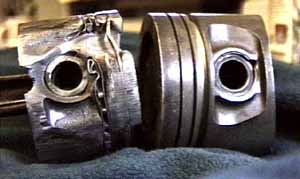
so the ecu sends less fuel to the engine, because it thinks that less oxygen molecules are entering your engine, creating lean conditions. lean conditions create more heat, which is good for exhaust gas velocity, but bad for pistons. this is why most cars run a little rich, just for reliabilities sake.
so, this chip will work, and may give you noticeable power, but it will affect reliability. our engines run rich, so leaning it down a bit can be good, but a resistor cannot do a good job of it. the air/fuel mixture needed is not exactly the same as the rpms increase, and a resistor cannot change the amount it "resists" to allow for this. this might mean that at 3k rpms, youre making more power by running only slightly rich, but once it goes up into the 5k+range, you might start running lean, which is never good.
damn i wrote a lot. if anyone sees any problems with it, correct it please. laugh.gif
i dont know which sensor it alters, it could be the IAT or the MAF. it doesnt matter though. it is a resistor, so it lowers the amount of voltage going to the ecu from one of these sensors. the ecu uses the amount of voltage coming back from these sensors to figure out how much fuel to throw in the engine. if the voltage is less, the ecu will think less air(if it affects MAF) or warmer air(if it affects IAT) is entering the engine.
if you guys remember the gas law from chemistry
P=pressure V=volume n=# of moles R= gas constant T= temperature
PV=nRT
we can arrange it to see the relationship between number of moles with volume and temperature.
n=PV/RT
looking at that, you can see the number of molecules will go down with an increase in temp. or with a decrease in volume.
the ecu thinks less fuel needs to be added after figuring out the lower than actual number of oxygen molecules that are going into your engine.
its less fuel that is bad for your engine. less fuel when the engine is up in high rpms will generate to much heat, and your pistons will melt. to much fuel can actually keep the engine a little cooler, but will create bad emissions and horrible gas mileage.
piston after running LEAN. the fuel pump failed at WOT and 20 psi.
so the ecu sends less fuel to the engine, because it thinks that less oxygen molecules are entering your engine, creating lean conditions. lean conditions create more heat, which is good for exhaust gas velocity, but bad for pistons. this is why most cars run a little rich, just for reliabilities sake.
so, this chip will work, and may give you noticeable power, but it will affect reliability. our engines run rich, so leaning it down a bit can be good, but a resistor cannot do a good job of it. the air/fuel mixture needed is not exactly the same as the rpms increase, and a resistor cannot change the amount it "resists" to allow for this. this might mean that at 3k rpms, youre making more power by running only slightly rich, but once it goes up into the 5k+range, you might start running lean, which is never good.
damn i wrote a lot. if anyone sees any problems with it, correct it please. laugh.gif

Senior Member
Joined: Mar 2002
Posts: 34,642
Likes: 0
From: Los Lunas, New Mexico, USA.
Vehicle: 2001 Hyundai Tiburon, 2004 Kia Sorento, 2010 Kia Soul
...
I do see something wrong with it, these resistors are supposed to make your car think there is MORE air going in, not less (Actually COLDER air, which is denser). Since the air going in is actually NOT more dense, you are having a RICH problem because the car is being told the air is COLDER/DENSER so it adds more fuel to make up for it.
These resistor "CHIPS" as they are called, do not do anything good for your car. You will just waste more gas (Our cars allready run "Pig" rich as it is), and you can get tons of other problems.
They do NOT work.
I do see something wrong with it, these resistors are supposed to make your car think there is MORE air going in, not less (Actually COLDER air, which is denser). Since the air going in is actually NOT more dense, you are having a RICH problem because the car is being told the air is COLDER/DENSER so it adds more fuel to make up for it.
These resistor "CHIPS" as they are called, do not do anything good for your car. You will just waste more gas (Our cars allready run "Pig" rich as it is), and you can get tons of other problems.
They do NOT work.
Thread Starter
Senior Member
Joined: Jul 2004
Posts: 1,093
Likes: 0
From: Seattle
Re: Throwin out an Idea
yeah, my thought was similar to redz
i was kicking around the fact that it's just telling the computer something that isn't correct about the mixture, which in ANY WAY is going to be detrimental
plus i also assumed i'd get even worse gas mileage (of course), but why would i want to alter the flow if it's not natural. i'm kinda' glad logic won and i made this thread today.
i was kicking around the fact that it's just telling the computer something that isn't correct about the mixture, which in ANY WAY is going to be detrimental
plus i also assumed i'd get even worse gas mileage (of course), but why would i want to alter the flow if it's not natural. i'm kinda' glad logic won and i made this thread today.
Senior Member
Joined: Mar 2006
Posts: 9,172
Likes: 0
Vehicle: 2001/Hyundai/Tiburon
the resistors cant make your car think more air is going in. the ecu sends out a certain amount of voltage to each sensor. the MAF sensor lets say is a resistor in itself, changin the amount of voltage it stops from going back to the ecu according to how much air it is detecting. these chips resist even more voltage from going back to the ecu. the ecu picks up less voltage, which makes it think less air is entering the engine, which also in turn makes it add less fuel. less fuel will mean to much heat.
Senior Member
Joined: Mar 2002
Posts: 34,642
Likes: 0
From: Los Lunas, New Mexico, USA.
Vehicle: 2001 Hyundai Tiburon, 2004 Kia Sorento, 2010 Kia Soul
QUOTE (tibby01)
the resistors cant make your car think more air is going in. the ecu sends out a certain amount of voltage to each sensor.
You are right, they CAN"T do that, but that's what the claim is, that they will make your car THINK there is COLDER and therefore MORE DENSE air going into your car.
Where do you keep getting that it's less air?

Senior Member
Joined: Jul 2004
Posts: 1,487
Likes: 0
From: Adelaide, OZ
Vehicle: Hyosung GT650
What about these chips? Are they any good, or a waste of resourses?
www.powerchipgroup.com/datasheets/1/Hyu0032.pdf
www.powerchipgroup.com/datasheets/1/Hyu0032.pdf

