


Which way is safer?





Moderator


Joined: May 2001
Posts: 7,166
Likes: 6
From: San Antonio, TEXAS!!!
Vehicle: 01 Tiburon Turbo, 99 Tiburon F2E, 2013 Avalon XLE Touring

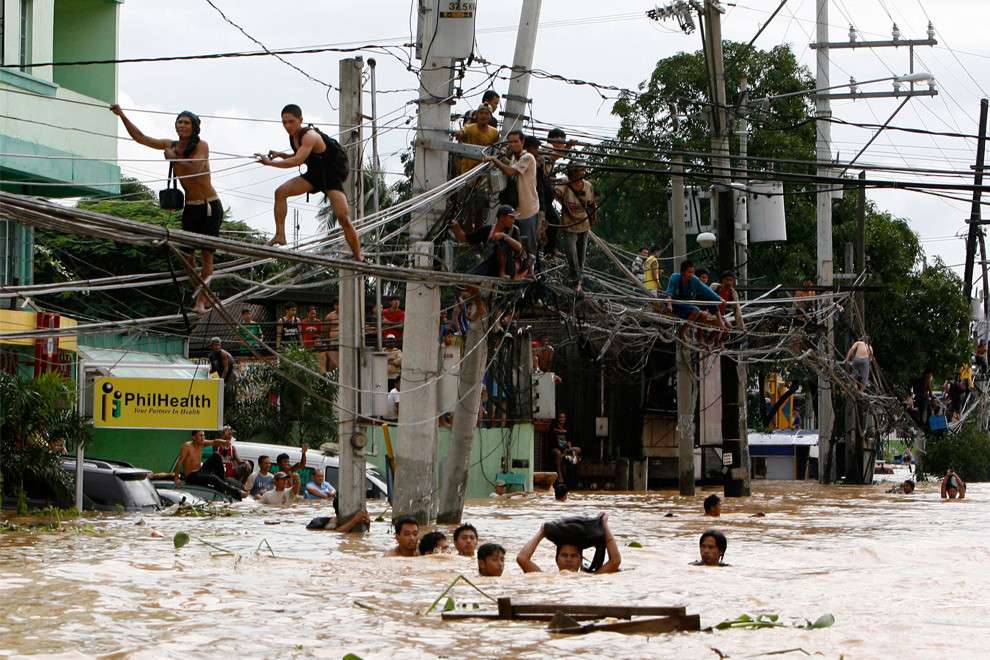
Incorrect. Those white cylinders are transformers. Notice the 37.5kw written on the sides. Enough to blow a hole through you twice.

Super Moderator

Joined: Sep 2001
Posts: 10,795
Likes: 5
From: Pflugerville, TX
Vehicle: 2000 Elantra
I notice the white cylinder in the background is fitted with tall insulators on top, and presume the one in the foreground is as well. The live wires are likely well over a meter, maybe two, above everyones' heads. There are wires tied to the bottoms of the transformers, but they are very likely not high tension cables.
Super Moderator
Joined: Sep 2001
Posts: 10,795
Likes: 5
From: Pflugerville, TX
Vehicle: 2000 Elantra
more than a couple inches. plus another 1.5m of transformer and insulator, yes...
On the assumption that 40kV would be easier to find a legit reference than 37.5kV, and that the hard-to-read character is a V (37.5kV), I went googling. For my final response in this thread: I say high.
From http://www.wapa.gov/rm/psmmCHAP-14.pdf
3.1.2 Arc Gap.
Arc gap (length) directly effects the level of heat transferred to a receiving
surface; as the length increases, the amount of heat that is transferred increases. It is
assumed that as a worker is performing a task, the initial arc is struck when a worker
takes a conductive article within the 60 Hz breakdown distance in air. The dielectric
strength of air is taken at 10 kV per inch. The calculated arc gap lengths are shown in
Table 3.1.2.
Line voltage: 69kV
Phase to ground voltage: 40kV
Arc gap (flashover) 40kV/10kV=4"
Line voltage: 500kV
Phase to ground voltage: 318kV
Arc gap (flashover): 318kV/10kV=32"
On the assumption that 40kV would be easier to find a legit reference than 37.5kV, and that the hard-to-read character is a V (37.5kV), I went googling. For my final response in this thread: I say high.
From http://www.wapa.gov/rm/psmmCHAP-14.pdf
3.1.2 Arc Gap.
Arc gap (length) directly effects the level of heat transferred to a receiving
surface; as the length increases, the amount of heat that is transferred increases. It is
assumed that as a worker is performing a task, the initial arc is struck when a worker
takes a conductive article within the 60 Hz breakdown distance in air. The dielectric
strength of air is taken at 10 kV per inch. The calculated arc gap lengths are shown in
Table 3.1.2.
Line voltage: 69kV
Phase to ground voltage: 40kV
Arc gap (flashover) 40kV/10kV=4"
Line voltage: 500kV
Phase to ground voltage: 318kV
Arc gap (flashover): 318kV/10kV=32"