


Custom fuel return system for 2003-2006 Accent 1.6L


Thread Starter
http://www.hyundaiaftermarket.org/images/vendor1.png

Joined: Jul 2008
Posts: 211
Likes: 0
From: Brisbane, Australia
Vehicle: 2003 Hyundai Accent 22PSI Boost
 Custom fuel return system for 2003-2006 Accent 1.6L
alrighty boys and girls,
factory standard the G4ED 1.6L accent/getz does not come with a fuel return system. I dont know what it is like in other countries, however i am a bit curious to see...
Alrighty, Car is getting a full rebuild and part of the rebuild is to put a rising rate fuel regulator on as i am running 2 fuel pumps (walbro gss342 as the intank, and a bosch 044 from the surge tank to motor). Now apart of a surge tank system you need a overflow from the surge tank back into the main fuel tank.
This is the issue... Where and how do i tap into the fuel tank again?
Possible solutions i have heard are:
1) The breather line that comes out of the tank and up to the fuel inlet nozzle, modify that and tap into there to return into the tank
2) Remove the carbon canister (???) and return througa overflow from your surge tank back into the main plastic fuel tank...
Help please
Cheers Ryan
factory standard the G4ED 1.6L accent/getz does not come with a fuel return system. I dont know what it is like in other countries, however i am a bit curious to see...
Alrighty, Car is getting a full rebuild and part of the rebuild is to put a rising rate fuel regulator on as i am running 2 fuel pumps (walbro gss342 as the intank, and a bosch 044 from the surge tank to motor). Now apart of a surge tank system you need a overflow from the surge tank back into the main fuel tank.
This is the issue... Where and how do i tap into the fuel tank again?
Possible solutions i have heard are:
1) The breather line that comes out of the tank and up to the fuel inlet nozzle, modify that and tap into there to return into the tank
2) Remove the carbon canister (???) and return througa overflow from your surge tank back into the main plastic fuel tank...
Help please
Cheers Ryan

Administrator

Joined: Mar 2006
Posts: 12,515
Likes: 2
From: Lacey, WA
Vehicle: Two Accents, Mini, Miata, Van, Outback, and a ZX-6
Please explain your entire system as you intend it to work after upgraded, except for the fuel return. I see no need to return it to the fuel tank as long as you return it to before your secondary pump.
Thread Starter
http://www.hyundaiaftermarket.org/images/vendor1.png
Joined: Jul 2008
Posts: 211
Likes: 0
From: Brisbane, Australia
Vehicle: 2003 Hyundai Accent 22PSI Boost

This is exactly how my system will be.... Once there is a surge tank... THERE MUST be a return overflow from the surge tank to the main fuel tank/fuel cell
Parts included are...
- 1 x walbro gss342 intank fuel pump
- 1 x Bosch 044 external fuel pump
- 2ltr Alloy surge tank
- -6an Braided lines
- -6an alloy fuel lines undercar
- Aeromotive fuel regulator
- Custom fuel rail
4 x 610cc (60lb) fuel injectors
Cheers Ryan

Senior Member
Joined: Feb 2010
Posts: 1,468
Likes: 0
From: Kent, Wa
Vehicle: 13 Gen Coupe Ult.
Thats seems to be pretty spot on, good diagram. Good luck with the build! With the whole tapping the tank for the return, go with the second one, you dont completely need the coal box, many people did the mod to remove it with no issues and simply cap it off, so using the vent line as a return, seems totally practical!
Administrator
Joined: Mar 2006
Posts: 12,515
Likes: 2
From: Lacey, WA
Vehicle: Two Accents, Mini, Miata, Van, Outback, and a ZX-6
IMO that is more complicated than necessary.
You have a lift pump for a returnless system already. IF it has the volume capabilities (if not replace it with a higher flow model) then I see no reason why you can't add an inline fuel pump to boost pressure and have it bleed off to a tee before the new pump.
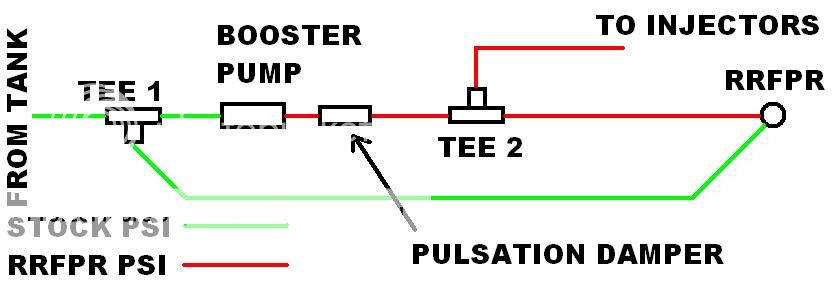
A return style fuel pump could not handle being stopped up like this, but to the in tank fuel pump it won't even know there's a difference.
You have a lift pump for a returnless system already. IF it has the volume capabilities (if not replace it with a higher flow model) then I see no reason why you can't add an inline fuel pump to boost pressure and have it bleed off to a tee before the new pump.
A return style fuel pump could not handle being stopped up like this, but to the in tank fuel pump it won't even know there's a difference.
Thread Starter
http://www.hyundaiaftermarket.org/images/vendor1.png
Joined: Jul 2008
Posts: 211
Likes: 0
From: Brisbane, Australia
Vehicle: 2003 Hyundai Accent 22PSI Boost
so what is this coal/carbon canister???
where is it???
what does it do???
why dont i need it???
Cheers Ryan
where is it???
what does it do???
why dont i need it???
Cheers Ryan
Senior Member
Joined: Feb 2010
Posts: 1,468
Likes: 0
From: Kent, Wa
Vehicle: 13 Gen Coupe Ult.
What is a Carbon Canister?
Carbon Canisters are devices found in automobiles designed to decrease the amount of air pollution the vehicle creates while at the same time increasing its fuel efficiency. Even when the vehicle's engine is turned off, hydrocarbons are produced. This occurs in the form of fuel vapor rising in the fuel tank. Carbon Canisters trap that vapor rather than allow it to escape the fuel tank, feeding it back into the engine.
Structure
Carbon Canisters are rectangular shaped boxes that sit apart from the fuel tank next to the throttle in most vehicles. There is an input port and an output port, with the two ports side by side. There are three chambers inside the canister, running in sequence from the intake to the outtake. The interior of the canister is filled with charcoal or carbon pellets. The input of the canister connects to the gas tank's vent port(This is the one you would need to tap to return the fuel), while the output connects to the purge valve in the side of the vehicle's intake manifold.
{you can find this under the car, on the left side, very easy to point out it is just a big black box and have lines to the fuel tank! Atleast that is where you can find it on a 99 Tib! This site has a DIY for the removal of this canister also!}
How does a Carbon Canister Work?
When the vehicle is shut off, there is a pressure imbalance within the fuel tank caused by fuel being siphoned out, but no air being let back in to take up the empty space. The lower pressure in the gas tank promotes a greater rate of evaporation, letting some of the fuel become a gas. Eventually the tank's internal pressure equalizes, at which point the gas leaves the tank through the vent port and goes into the carbon canister. It's trapped there by the properties of the carbon within the canister, keeping it from escaping into the air. When the vehicle's engine starts, the sudden suction created along the intake manifold opens up the purge valve and pulls all the gaseous fuel out of the canister and burns it in the engine. The canister goes unused until the car is turned off again.
Hope this is a little help!
Carbon Canisters are devices found in automobiles designed to decrease the amount of air pollution the vehicle creates while at the same time increasing its fuel efficiency. Even when the vehicle's engine is turned off, hydrocarbons are produced. This occurs in the form of fuel vapor rising in the fuel tank. Carbon Canisters trap that vapor rather than allow it to escape the fuel tank, feeding it back into the engine.
Structure
Carbon Canisters are rectangular shaped boxes that sit apart from the fuel tank next to the throttle in most vehicles. There is an input port and an output port, with the two ports side by side. There are three chambers inside the canister, running in sequence from the intake to the outtake. The interior of the canister is filled with charcoal or carbon pellets. The input of the canister connects to the gas tank's vent port(This is the one you would need to tap to return the fuel), while the output connects to the purge valve in the side of the vehicle's intake manifold.
{you can find this under the car, on the left side, very easy to point out it is just a big black box and have lines to the fuel tank! Atleast that is where you can find it on a 99 Tib! This site has a DIY for the removal of this canister also!}
How does a Carbon Canister Work?
When the vehicle is shut off, there is a pressure imbalance within the fuel tank caused by fuel being siphoned out, but no air being let back in to take up the empty space. The lower pressure in the gas tank promotes a greater rate of evaporation, letting some of the fuel become a gas. Eventually the tank's internal pressure equalizes, at which point the gas leaves the tank through the vent port and goes into the carbon canister. It's trapped there by the properties of the carbon within the canister, keeping it from escaping into the air. When the vehicle's engine starts, the sudden suction created along the intake manifold opens up the purge valve and pulls all the gaseous fuel out of the canister and burns it in the engine. The canister goes unused until the car is turned off again.
Hope this is a little help!
Thread Starter
http://www.hyundaiaftermarket.org/images/vendor1.png
Joined: Jul 2008
Posts: 211
Likes: 0
From: Brisbane, Australia
Vehicle: 2003 Hyundai Accent 22PSI Boost
So all cars have one of these??? to be honest i have never seen it under the car before however i will check one out at the wreckers tommorow as the car is in storage. Unless someone here has a lc2 accent and can take a photo for me lol... i am a bit lazy on a sunday smile.gif
Edit: Went looking for the DIY and cant find it, If anyone knows the link could you post it please, it would be greatly appreciated.
Cheers Ryan
Edit: Went looking for the DIY and cant find it, If anyone knows the link could you post it please, it would be greatly appreciated.
Cheers Ryan
Senior Member
Joined: Feb 2010
Posts: 1,468
Likes: 0
From: Kent, Wa
Vehicle: 13 Gen Coupe Ult.
I have worked on a few cars that were pre coal canister, So not all cars have one. Im sure sense they are use mainly for fuel efficency that all the newer cars got em. But that doesnt help ya so...
Sorry about the DIY thing, didnt mean to make you run around the net to look for it, it was on NT.COM here is the link to the forum!
DIY FOR COAL CAN DELETE
Sorry about the DIY thing, didnt mean to make you run around the net to look for it, it was on NT.COM here is the link to the forum!
DIY FOR COAL CAN DELETE
Thread Starter
http://www.hyundaiaftermarket.org/images/vendor1.png
Joined: Jul 2008
Posts: 211
Likes: 0
From: Brisbane, Australia
Vehicle: 2003 Hyundai Accent 22PSI Boost
hey thats ok mate, im gonna throw a spanner in the works here...
if that is supposed to be releasing built up pressure in the tank, changing it to be a inlet to the tank surely ill run into issues...???
Cheers Ryan
Edit: hey the wreckers i went to have moved the accent into a manner in which i cant get to it and my car is in storage, anyone with a lc2 accent able to take a photo for me please???
if that is supposed to be releasing built up pressure in the tank, changing it to be a inlet to the tank surely ill run into issues...???
Cheers Ryan
Edit: hey the wreckers i went to have moved the accent into a manner in which i cant get to it and my car is in storage, anyone with a lc2 accent able to take a photo for me please???